Muzzle Brakes vs. Flash Hiders vs. Compensators
Muzzle devices! There are
lots of ’em. You’ve got muzzle brakes, and flash hiders, and compensators, and suppressor. What’s the difference between all of these? What’s a pinned and welded flash hider? Which device should I get? Let’s answer all the questions and compare muzzle brakes vs. flash hiders vs. compensators.
Muzzle Device FAQs
Q: What is a muzzle device?
A: A muzzle device is a device that threads, clips, or otherwise connects to the muzzle of your firearm. The AR-15 is the one firearm that uses muzzle devices more than any other long gun or handgun.
Q: What’s the purpose of a muzzle device?
A: Muzzle devices provide different advantages. Some reduce felt recoil to make shooting your gun easier. Others reduce muzzle rise to improve accuracy. Some can reduce muzzle flash (the fireball that comes out of your muzzle) or deflect harmful noise and gas away from the shooter.
Q: What it mean to “pin and weld” a muzzle device?
A: The Bureau of Alcohol, Tobacco, and Firearms (ATF) does not count a removable muzzle device as part of your firearm’s barrel length. Some gun owners permanently attach their muzzle device by paying a gunsmith to pin and spot weld the device so it can’t be removed.
Q: What’s the point of a permanently attached device?
A: A permanently attached muzzle device is considered part of the barrel length. Welding a muzzle device allows a gun owner to increase a barrel’s length to 16″ or more. This is helpful for those who want to legally own a short-barreled rifle without the paperwork.
Q: What are the differences between muzzle devices?
A: Let’s compare!
Muzzle Brakes
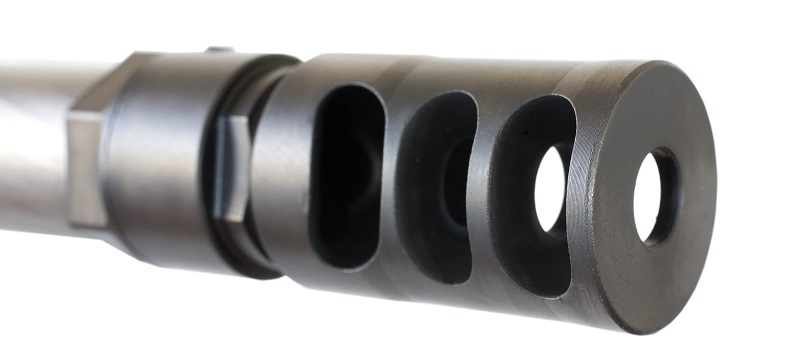
Pictured: Midwest Industries AR Muzzle Brake
Muzzle devices divert the hot gasses produced at the muzzle back toward the shooter, generally to the left and right sides. Redirecting this energy backwards and to the sides of the shooter helps to cancel out felt recoil. Of course, this doesn’t reduce any energy produced. That means all that gas, heat, sound, and pressure must still go somewhere — typically toward those who may be shooting next to you.
The muzzle brake’s recoil-reducing ability makes it the most popular muzzle device for shooters who chamber large calibers. Think of big rounds like .308 Winchester, .300 Win Mag, .50 BMG or .50 Beowulf.
Pros
- Muzzle brakes reduce felt recoil significantly
- Helps to keep muzzle on target during rapid fire
- Reduced recoil improves accuracy and confidence
Cons
- Brakes may significantly increase perceived loudness
- May cause discomfort to nearby shooters at a shooting range
- Gasses expelled toward to the shooter create a concussive effect
Compensators
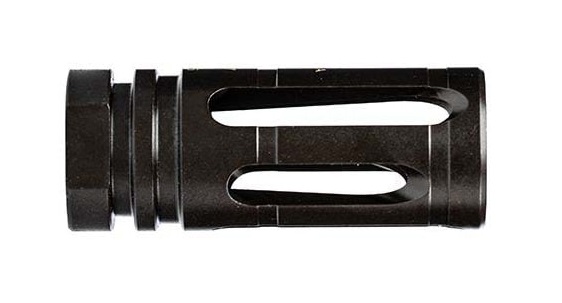
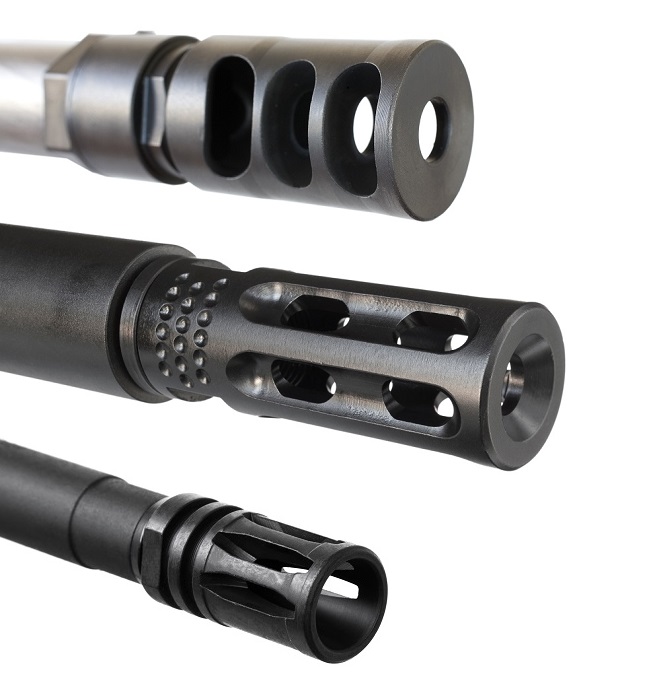
Pictured: Aero Precision VG6 Delta 556 Compensator
Think of compensators as fancy muzzle brakes: They, too, divert the gasses expelled at the muzzle in other directions, in order to cancel out the forces that work against the shooter. Except where muzzle brakes divert gas backwards, compensators divert gasses up and outward.
This up-and-outward redirecting of gasses helps cancel out muzzle rise. Reducing muzzle rise means your point of aim stays on-target between shots, and your sight picture isn’t disturbed as greatly. Automatic or rapid fire can cause muzzle rise to become uncontrollable. So, compensators are often used on automatic weapons and rifles equipped with binary triggers.
Pros
- Significantly reduces muzzle rise after each trigger pull
- Allows for an uninterrupted sight picture between shots
- Improves full-auto accuracy by keeping muzzle on-target
Cons
- May still divert hot gasses toward the shooter
- May also still create concussive blasts to those nearby
- Does not reduce felt recoil as much as a muzzle brake
Flash Hiders / Flash Suppressors
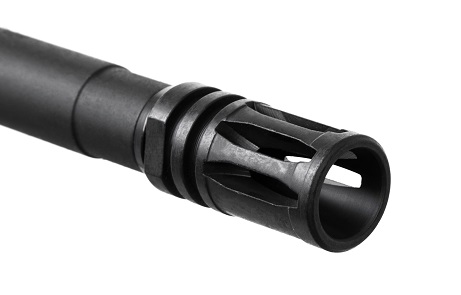
Pictured: Classic A2-Type “Birdcage” Flash Hider
The flash hider (or flash suppressor) is the most common muzzle device you’ll find on AR-15s, especially on entry-level or store-bought guns. The classic A2-type flash hider like that exampled above doesn’t significantly reduce felt recoil or muzzle rise.
Instead, a flash hider’s job is to eliminate the fiery blast that accompanies a bullet when it exits the barrel. An an “open” muzzle, the gasses exiting the barrel form a bubble of super-heated gas. This bubble produces visible light in a vacuum, just like an incandescent lightbulb. To eliminate this vacuum and flash, a flash hider creates turbulence. This turbulence prevents this bubble vacuum from forming.
The A2 flash hider directs gas upwards, like a compensator. This is done to reduce the dust signature produced by those gasses when firing in the prone position. This design also helps reduce muzzle rise to a lesser degree, though many flash hiders expel gas in all directions.
Pros
- Reduces bright muzzle report, effective for night shooting
- Reduce shooter’s signature in a tactical situation or fire fight
- May help to slightly reduce felt recoil and muzzle rise
Cons
- Designed primarily for obscuring precise location of small arms fire
- Not the most effective muzzle device for average civilian shooter
- Doesn’t reduce recoil or muzzle rise as well as a compensator or brake
Quick-Detach (QD) Muzzle Devices
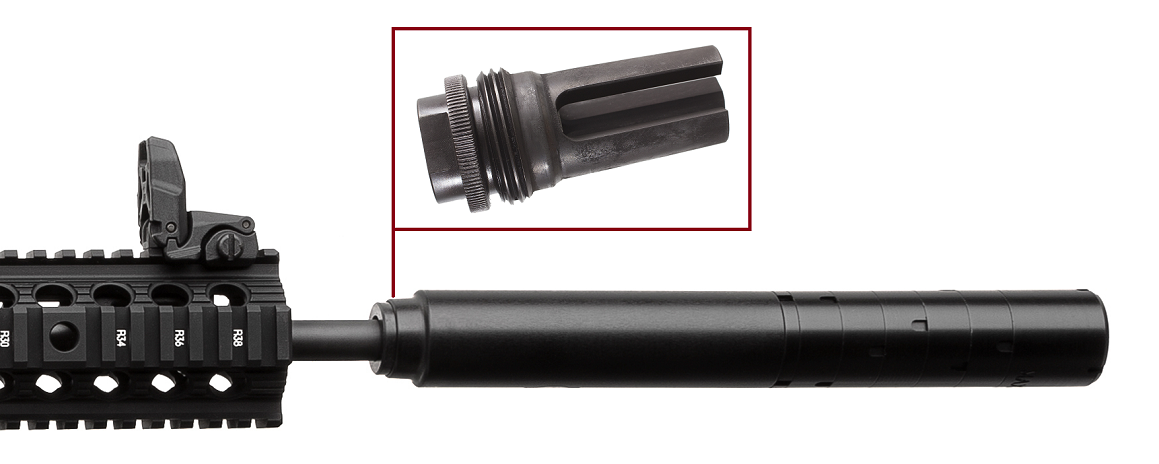
Want to use a suppressor as your muzzle device? You should invest in a muzzle device that’ll be compatible with your future suppressor. Take a look at the three-pronged flash hider pictured above and you’ll notice that it has threads on the outside, at its base. That’s because this flash hider also acts as a quick-detach (QD) mount for a suppressor.
Suppressors and Quick-Detach.
Most modern suppressors are designed to attach and detach quickly to a muzzle device instead of directly to the barrel’s threads. But why?
QD suppressors are quieter.
The first chamber inside a suppressor is called the blast chamber. The blast chamber surrounds the muzzle. It’s responsible for reducing the initial high-energy sound produced at the muzzle. A cold suppressor can suffer an effect called “first-round pop” or FRP. This phenomenon occurs when oxygen inside the blast chamber is ignited, producing a sound that’s louder than the shots immediately following it.
With a QD device taking up volume and creating turbulence inside the blast chamber, FRP is reduced. Gas leaving the muzzle is made more turbulent, and sound is further reduced when compared to a direct-thread setup.
QD setups are convenient.
Suppressors can be fitted and removed from a QD muzzle device quickly, without the need for tools. Since the QD device is permanently installed, it acts as a standard brake, comp, or flash hider when firing un-suppressed.
Recap
Now you know the differences between all three types of firearm muzzle devices: Flash hiders, muzzle brakes, and compensators. And you’re on the up-and-up when it comes to suppressors and Quick Attach setups for shooting suppressed.
Here are the important points to remember:
- Muzzle brakes are made to reduce recoil.
- Compensators are made to reduce muzzle rise.
- Flash hiders are made to eliminate muzzle blast.
- A muzzle device can be permanently welded to increase barrel length.
- Suppressors and suppressed rifles work best with QD muzzle devices.