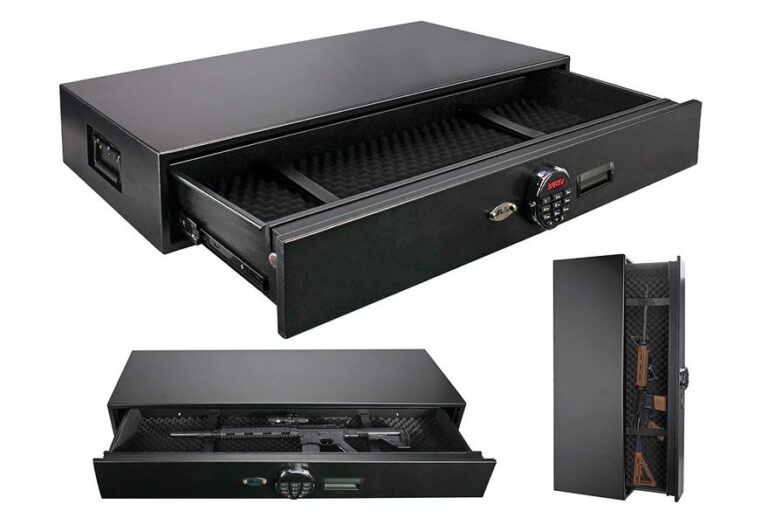
The Ultimate Gun Safe Guide: Intro, Specs & Locks
Keeping your guns
safe is as important
as exercising your Second Amendment right. If you’re one of the millions of
gun owners in America, you’re probably looking for
a good gun safe. But shopping for the
right gun safe is difficult. There are endless brands to pick from,
misleading ads, countless price points, too many features, and loads of questionable specs. Let’s clear it up.
Part one: We’re covering gun safe protection ratings, performance against attacks,
theft and fire, physical specs like steel thickness and fire insulation,
the standards used to certify safes, and gun safe locks.
Part two: We’ll cover our top picks for gun safes with honest reviews. First handgun safes, then rifle safes.
Note: We partner with affiliates to provide links to products in this
review. We may earn a small commission if you click a link.
Gun Safe Protection Ratings
Before buying a safe, you must understand safe protection ratings. You might buy a bad safe if you don’t know the
jargon. Safe protection ratings describe a unit’s overall
effectiveness: How well it can protect against physical attack and theft,
and fire.
One organization is responsible for creating and assigning “official” gun safe protection ratings:
Underwriters Laboratories (UL)
When shopping for a safe, you’ll often see the acronym, “UL”. The
Underwriters Laboratories (UL) is an
American safety certification company. It tests building
products, plastics, wires, cables, and security equipment, including
locks and safes.
When shopping for any gun safe, you should try to find one that’s UL-certified.
UL ratings indicate how well (and for how long) your safe can protect
against attacks from thieves.
UL Safe Protection Ratings Against Attack:
RSC (Class 1, Minimum)
A basic certification provided by UL, the Residential Security
Container or RSC is a type of locking storage unit that provides
protection against attack by common mechanical and electrical hand
tools. The safe or container must withstand “rigorous prying, drilling,
punching, chiseling, and tampering for five minutes.” This is less
impressive than it sounds. Hand tools for this test include hammers less
than 3 lbs., pry bars shorter than 18″, and basic residential tools
like screwdrivers.
The RSC rating is considered the minimum protection rating any safe
should provide. This is the most common level of protection you’ll find
in handgun or “nightstand” safes and portable lock boxes. It’s adequate
for keeping family, friends, and opportunistic burglars away from your
firearms but will provide only basic resistance against a thief with
tools.
TL-15 / TL-15X6 (Class 2)
The next level of UL-certified protection is a TL-15 or TL-15X6 rating.
The base rating covers the door, while X6 indicates the same level of
protection is provided for all six sides of the safe. This certification
is given to safes capable of protecting against attacks with common
mechanical and electrical hand tools for a net working time of 15
minutes. Working time is the total time spent by an attacker attempting
to break the safe. A TL-15 safe can resist entry much better than an
RSC-rated container: It can defeat tools a prepared thief might bring
along: Grinders, carbide drills, and high-pressure cutting or crushing
tools.
TL-30 / TL-30X6 (Class 3)
The TL-30 and -30X6 rating provides more protection than TL-15, both in
time and tools used to attack. In addition to protecting against
grinders, carbide tools and high-pressure tools for 30 working minutes, a
TL-30 safe can withstand abrasive cutting wheels and power saws. The
base rating also applies to the door, and X6 applies to all sides.
TRTL-30 / TRTL-30X6 (Class 3+)
The modern thief could have access to a torch or other high-heat
source. So, modern safes are now rated against torch attacks. The “TR”
in a TL- certification indicates this. Like tool attacks, torch
attack-rated safes can either withstand 15 or 30 minutes of attack
before failure. Safes are rated for doors only or all sides.
TXTL-60X6 (A Class All Its Own)
The Mack Daddy of safes in terms of raw protection. A TXTL-certified
safe protects against explosive attacks, in addition to providing all
the protections of the lesser ratings for no less than
60 working minutes. Yes, it resists explosives for one hour.
At this level, you’re working with a safe that that could function as a
small bank vault or fallout shelter.
Gun Safe Steel Thickness
You’ll see a lot of safes advertising a 12-gauge body or 10-ga. steel
door. Gauge is a jazzy way of describing the thickness of the safe’s
steel, expressed in the chart below. The higher the gauge, the thicker
the steel. Whether cold- or hot-rolled, thickness typically deviates +/-
0.006 to 0.009.
The chart below converts steel gauge to thickness (inches).
“How thick should my gun safe be?”
High-quality rifle safes often have layers of steel that
increase their overall thickness beyond 3-gauge plating. Handgun safes usually only have a single layer of steel.
Long gun safes should have at least 10-gauge steel walls and a 10-gauge door to provide adequate
protection against sustained physical attack with cutting tools. Pistol safes and ligh lockboxes
use thinner gauge steel to balance protection and weight.
Gun Safe Fire Protection Ratings
Gun safe fire ratings are often questionable.
Many companies advertise fire protection ratings for their safes. But quite often, those ratings
can’t be trusted because they aren’t certified through standardized testing of any kind. Safes with reliable fire protection are
certified by Underwriters Labs. Other large safe brands, like Liberty Safes,
use their own testing methods, which may also be considered reliable. Handgun safes and all those “Amazon specials” that advertise
fire protection ratings should be taken with a grain of salt if they’re
not UL-certified.
You should trust Underwriters Labs for fire protection ratings.
All safes with a UL fire protection rating undergo standardized testing. UL tests safes by heating them for 60 minutes at temperatures that simulate a typical house fire. Each safe’s ability to insulate their interior against the exterior temperature is recorded with a thermometer. UL tests safes at different temperatures and for different lengths of time:
- 30-minute safes: 1550°F
- 1-hour safes: 1700°F
- 2-hour safes: 1850°F
- 3-hour safes: 1920°F
- 4-hour safes: 2000°F
To receive the minimum UL fire rating, a safe’s internal temperature
can’t exceed 350°F. Safes with internal temperatures that don’t exceed
125°F receive the highest rating. For reference, the melting point of a
polymer handgun is 420°F.
UL Safe Fire Ratings Explained
A safe with a fire rating of
UL 350-1 can keep its internal temperature at 350°F for one
hour when heated to 1,700°F externally. The best possible rating a safe
can receive is
UL 125-4. That means it can keep its internal temperature below 125°F for four hours when subjected to 2,000°F. That’s an impressive but very
expensive rating.
The 30-minute UL fire rating can be found in some
handgun safes, but better ratings are typically found in long gun
safes and heavily insulated rifle cabinets. Some safes may have fire ratings
that provide 350°F of internal temperature at 1,300°F or some other
lower temperature.
“How are gun safes made to be fireproof?”
A fireproof material is placed between a safe’s layers of steel to insulate
against open flames and heat. It’s not the steel, but the layers of fireproofing that make a gun safe’s door seem so thick.
Multiple layers must be used to provide adequate protection against a
house fire, which can reach temperatures of 1,200°F in as little as five
minutes.
Critical points of a safe — door jambs, corners, welds — must be
properly insulated, too. To effectively protect against heat, the door
must use special heat-expanding seals.
Safe fireproofing materials include:
- Sheetrock and fireboard. This is an “entry-level” material that provides moderate protection. It’s often found in
budget, RSC-rated cabinets and long gun safes with minimum advertised fire
protecting ratings. - 2300-Degree Ceramic. Ceramic fiber provides the best protection against
fire, but it is expensive and often found in mid-grade to high-end
safes. - Cement and Dry Composite. Actual cement
can be used, though it’s typically reserved for commercial and
industrial safes, and old-school safes from decades past. Today, dry
composites that are cement-like but much lighter have replaced
traditional mixtures.
Types of Gun Safe Locks
Your gun safe’s lock is incredibly important: It controls access to your firearms, and it’s the first thing any thief will attack if they want to get inside. Gun safes use all kinds of locks: Digital
locks, mechanical key or combination locks, tumblers, and punch buttons. Let’s compare them all.
Combination Lock (Mechanical/Digital)
UL-listed S&G mechanical lock for a Liberty Gun Safe.
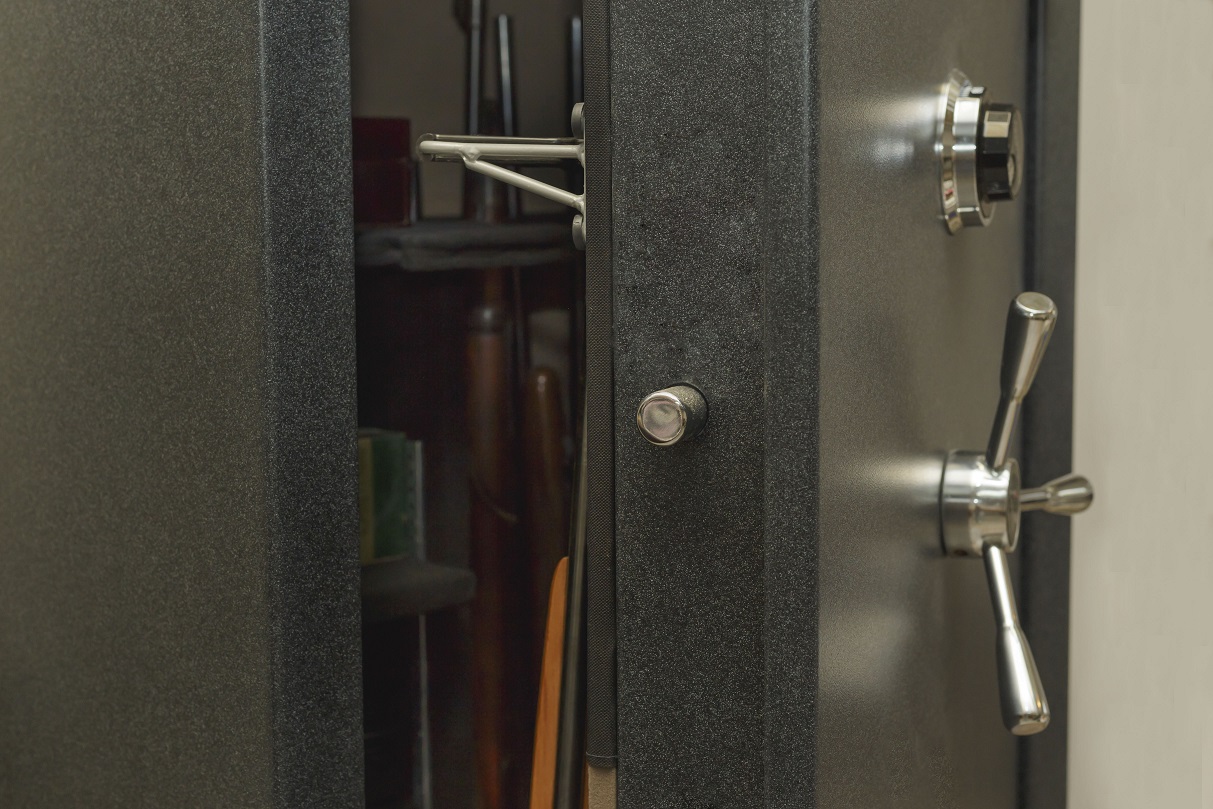
When it comes to rifle safes, the combination lock is the most popular type of lock. Mechanical combo locks use a series of geared wheels controlled by a numbered dial used to enter the combo. Around 10% of safes sold each year are fitted a mechanical
dial like the one above.
The mechanical combination lock is complex and expensive to make, but it’s a
timeless piece of engineering that provides high security. It can’t be picked like a keyed lock and it never requires batteries, so there’s no need to disassemble the lock or temporarily disable your safe.
An S&G Electronic Combination Lock
Electronic combo locks are
simpler and more affordable than mechanical combo
locks. In some cases, digital locks may be more difficult to break than a mechanical lock. Digital
locks provide the user with a button keypad. Once the correct digits are entered, a
wire carries a signal from the keypad to motors that control the deadbolts inside the safe’s door.
“Which combo lock is better? Mechanical or digital?”
Even though electronic locks vastly outsell mechanical locks, it’s
important to compare the two. Every person’s needs are different, and
one lock might provide that distinct advantage you want or need.
Security
Since most safes sold
today are electronic, the first question most ask is, “How reliable is
an electronic lock?” The answer is: It depends. If the lock is rated to UL’s standards, then it will provide high security. UL Standard 768 is Department of Defense- and ANSI-approved. Any 768-rated electronic combo lock will repel attacks as well as a mechanical combo lock. The
keypad is not directly connected to the deadbolt that locks the handle,
so destroying the keypad doesn’t won’t provide access to the safe.
Winner: Tie
Accessibility
Which lock provides the easiest access? The
electronic lock. The combination can be
entered in a few seconds. Even the smoothest and simplest
mechanical lock will take longer to access.
Pressing a series of keys requires basic motor skills in an emergency,
but entering the combination on a dial requires fine motor skills. The electronic lock is less likely to get you stuck if
seconds count and your hands are shaking.
Winner: Electronic
Reliability
Electronic keypads require batteries to be changed every 3 month to 1
year. Most are expected to operate for 3 to 10 years. This is poor
performance compared to a mechanical dial, which requires no
power and can run its gears and pins reliably for well over a century
with daily use. If you’re interested in a lock that can withstand the
tests of time, mechanical is the way to go.
Winner: Mechanical
Ease of Combination Change
This is something many don’t think about: You might want or need to
change the combination on your safe. Mechanical safes often require a locksmith to
change the combination, since physically changing the wheel pack is
almost always required. Electronic locks can be
reprogrammed with a few button presses, eliminating the need for this
costly and time-consuming service.
Winner: Electronic
Extra Features
Everyone likes more bang for the buck. The electronic lock is obviously
the winner, but you probably knew that. Most electronic locks allow for multiple
combinations. Some provide access logs. Others offer Bluetooth connectivity for constant monitoring, with silent alarms that’ll notify you of an attempted entry. Mechanical locks don’t come with any of these features.
winner: Electronic
Quirks
Mechanical locks suffer few to no quirks. If you can turn the dial in the correct direction and
hit each number, nothing will fail you. Electronic locks can suffer from quirks. You could punch in the
wrong number and lock yourself out for five minutes. Low battery? No battery? Locked out. Change the code and forget it? Locked out.
Winner: Mechanical
Simplex Lock
The Desk Mate Handgun Safe from V-Line uses a Simplex lock.
Mechanical and digital combos each have their unique advantages. You’ll
be happy to know there is a combination, pun intended, of the two locks
available for most types of gun safes. The Simplex lock is found on
thousands of bank and casino doors and industrial complexes. It uses a
punch pad with five buttons which, when pressed in a certain pattern,
create the combination required for entry. Each button on the Simplex
lock is a binary command, 0 or 1. The five-digit combination can be
anything the user sets: 01010, 00011, 10010.
Simplex Lock Pros
The Simplex offers the advantages of a digital
and mechanical combination without the disadvantages of
either. It provides quicker access to the safe than even a digital lock.
No batteries are required, so there aren’t any electronics to fidget
with. The combo can be entered instantaneously to provide emergency
access. It can also be easily changed by the user, no locksmith is
needed. It’ll last for decades, it’s stupid easy to use, and it doesn’t
require a steady hand to open.
Simplex Lock Cons
There are few cons with the Simplex lock other than its relative
weakness compared to high-end digital and mechanical combos. The buttons
on the Simplex are easier to attack and destroy than the dial on a
mechanical combo, and unlike the remote connection of a digital combo,
the Simplex mechanism must be directly connected to the handle to
control access. With that said, a well-rated Simplex lock with UL
certifications will defeat a thief just as well as any other type of gun
safe lock with the same UL rating.
Biometric Fingerprint Lock
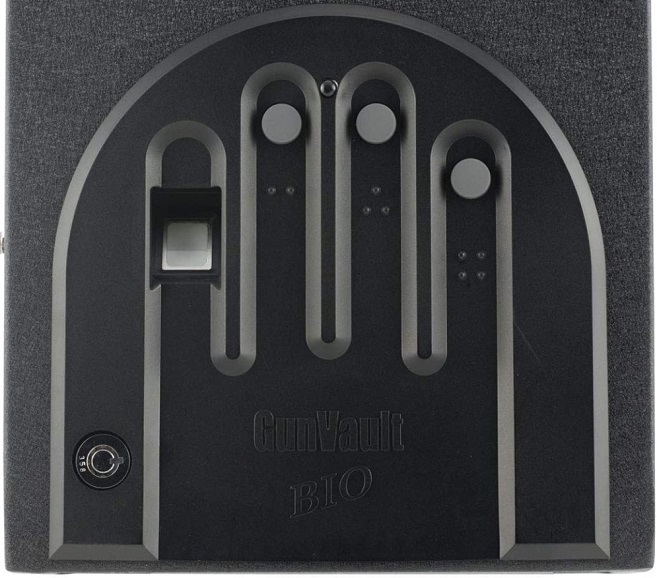
The Gunvault Minivault Pistol Safe uses a biometric lock.
Biometric fingerlock locks are found on entry-level long gun
safes and portable pistol safes, with higher-end safes providing the
biometric as an alternative or backup to a combination lock. Set up the lock by letting it read and
store your fingerprints. When you want access, press your fingers down
on the pad. A laser reads the unique signature of your fingertips
to provide access.
Biometric Lock Pros
It doesn’t get much easier than the biometric lock when it comes to
safe access. Biometric
locks read your prints faster than you can key in the numbers on a
combo lock. They’re perfect for nightstand safes
and pistol lockboxes. These locks often come with extra features. Most can
store at least 5 different sets of prints. Some can store 100 or more. Overkill, yes.
Often, you’ll be provided Bluetooth connectivity and some sort of
smartphone app to monitor your biometric lock’s status, battery life,
alarm system, log of prints and use. Like a digital combo lock, biometric locks are connected via a
wire to the deadbolt or locking mechanism on the safe’s door or lid. Destroying the biometric scanner doesn’t provide access.
Biometric Lock Cons
Biometric locks are rarely UL-listed and suffer most of the digital
lock’s problems: They require batteries or a power source.
They aren’t as durable as other locks and can be broken easily.
Low-end and budget scanners suffer frequent problems, like
failing to scan prints and denying access. It’s a good
idea to check reviews on these scanners before
purchasing any biometric gun safe.
Key Lock
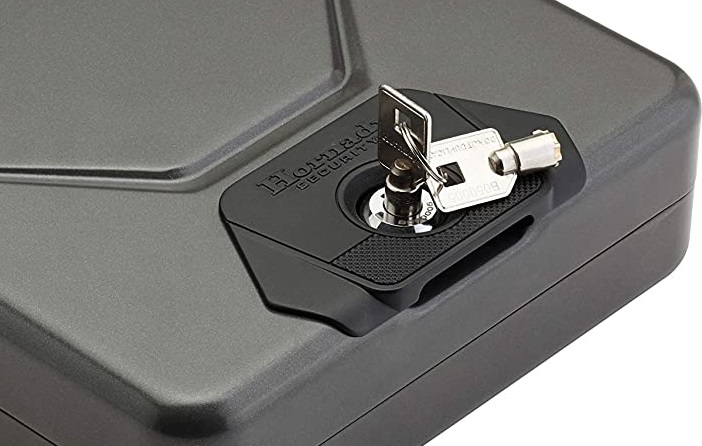
The key lock uses the classic key and tumbler to
provide access. These are almost exclusively found on small pistol lockboxes,
like the Hornady box shown above. Key locks are also used on entry-level gun
cabinets. Gun safes with digital combo locks sometimes have backup key locks.
Key Lock Pros
Key locks are the most compact and lightweight. Many are TSA-approved,
too. They’re great for travel safes for this reason. Key locks are
typically reliable. They’re mechanical and don’t need batteries. No
programming, and no smartphone app to mess with. They’re usually very
affordable, too.
Key Lock Cons
Key locks are relatively weak compared to other locks and don’t provide
much protection against an attacker with tools. If you lose the key,
you’re out of luck unless you pay a locksmith who can crack it. There’s
no guarantee the lock can be saved if you lose the key, making your safe
a paperweight. Those keys can get stolen, too. Key locks take time to
open compared to any digital lock. Only the mechanical dial is slower.
It’s best to stick with a key lock if you need a highly portable or
compact safe and you don’t like electronics, or you’re traveling by
plane.
“Briefcase” / Tumbler Combo Lock
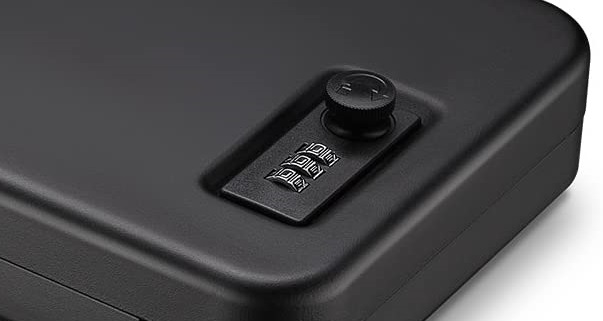
It’s an age-old lock, but it’s still in use today. The “briefcase”
wheel-driven tumbler lock is found on small pistol safes and travel
lockboxes. Most use three to four wheels that unlock a rotating knob
which controls a small lever or deadbolt inside the safe lid or door.
Tumbler Lock Pros
The tumbler combo lock provides the same benefits of a key lock,
without the risk of losing the key. These tumbler locks are compact and
take up less space than just about any other locking mechanism, so
they’re perfect for the pistol owner who needs an ultralight, small
locking container for frequent travel. Like key locks, units equipped
with tumbler locks are among the most affordable in the pistol safe
category.
Tumbler Lock Cons
Beyond portability and the lack of a key to lose, the wheel
combo lock provides no advantage over other locks. These locks can be easily
defeated, and destroying them usually
provides access to the safe’s contents. The combination cannot be changed
and they afford little security otherwise. These are best for
backpackers and on-foot shooters who want to merely keep prying eyes away and children from
making an opportunistic entry.
Gun Safe Intro Guide: Recap & Part 2
This section was a wall of text, we know. Nonetheless, it’s critically
important you have a solid reference for the endless specs and
advertised “features” gun safes claim to come with. Here’s the important
stuff from earlier.
- The Underwriters Laboratory (UL) certifies top gun safes’ protection ratings.
- An “RSC” rating indicates the UL’s minimum certified gun safe protection.
- To receive the minimum UL fire rating, a safe’s internal temperature can’t exceed 350°F.
- Safes with internal temperatures that don’t exceed 125°F receive the highest rating.
- For reference, the melting point a GLOCK’s polymer frame is 420°F.
- To receive the minimum UL fire rating, a safe’s internal temperature can’t exceed 350°F.
- Safes with internal temperatures that don’t exceed 125°F receive the highest rating.
- About 90% of long gun safes are fitted with digital combination locks today.
- Biometric fingerprint locks are the most popular access method for pistol lockboxes.
Now you’ve got a good warm n’ fuzzy about
all the things that go into a quality firearm safe. Next up,
it’s time to look at some of the best safes available for different
categories. Part 2 covers best pistol safes.