Reflex & Red Dot vs. Holographic Optics Explained
Red dots, holographics, ACOGs, Aimpoints, what does it all mean?! Today, we’re going to clear up the misconceptions and mysteries about red dot optics. Let’s clear up what types of red dots there are. Then we’ll compare how each type works, and its pros and cons. Lastly, we’ll dispel some myths and misnomers about laser optics in general.
What’s a Red Dot Sight?
A red dot sight is a type of battery-powered optic that uses a glass lens, housed inside a tube or frame, and a laser or LED to project a “floating” reticle in the center of the optic. This floating reticle acts as your point of aim.
There are loads of battery-powered optics that use diodes, LEDs, and glass to project a reticle. But we gun lovers tend to lump them all into a single “red dot” category. However, a red dot sight, officially called a reflex sight, is just one type of battery-powered optic. Holographic sights (like EOTechs) also produce reticles using a laser, and holographic sights and reflex sights are not the same. Each has unique benefits and drawbacks.
Confused? Let’s clear it all up.
Reflex Sights
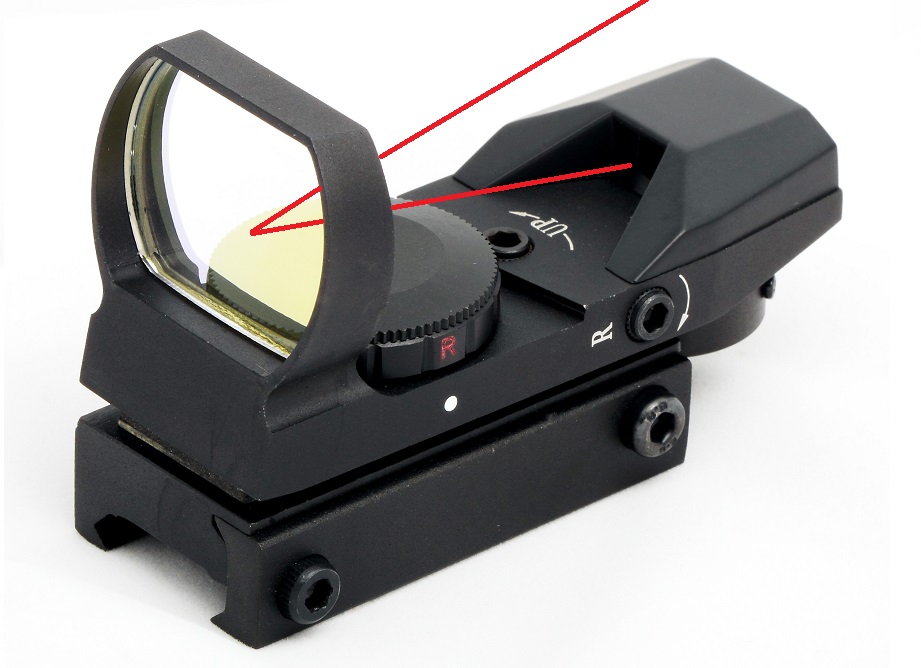
When you think of a red dot sight, the reflex sight is probably the type of optic you’re imagining. The reflex sight is the simplest battery-powered optic. It uses a single piece of glass, coated with a special reflective treatment.
This coated glass acts like a mirror for an LED-produced reticle. The reflective treatment focuses and reflects the reticle back toward the shooter’s eye, while allowing regular light to pass through.
How reflex sights create a reticle:
The shape of a reflex sight’s reticle is not produced by the glass viewing pane. A second, much smaller etched piece of glass, called a diaphragm, acts as a focus and filter for the LED. The diaphragm contains the shape of the reticle that the optic will produce. The shaped reticle is projected onto the sight’s glass pane when the LED’s light passes through the diaphragm.
Reflex sights are available in a variety of configurations. An “open” reflex sight (like this Bushnell AR Red Dot) uses a single framed piece of glass with an exposed LED at the rear of the optic. Tube-style reflex
slights (like this Sig Romeo MSR) provide a brighter reticle
in a tubular housing that can take a bit more abuse.
Pros
- Since reflex sights use a diaphragm, the reticle is always in focus at any distance.
- The open reflex sight’s single pane of glass allows the optic to be compact and lightweight.
- Since the reticle is projected directly onto the eye, the shooter enjoys unlimited eye relief.
- Reflex LEDs use almost no power, and can run continuously for thousands of hours.
- Reflex sights can be made small enough for fitment on a handgun, like the Romeo1 PRO.
Cons
- If a reflex sight’s glass cracks, the reticle can no longer reflect properly.
- Reflex sights can suffer from mild parallax error when aiming.
- That means your eye position will change the reticle’s position.
Holographic Sights
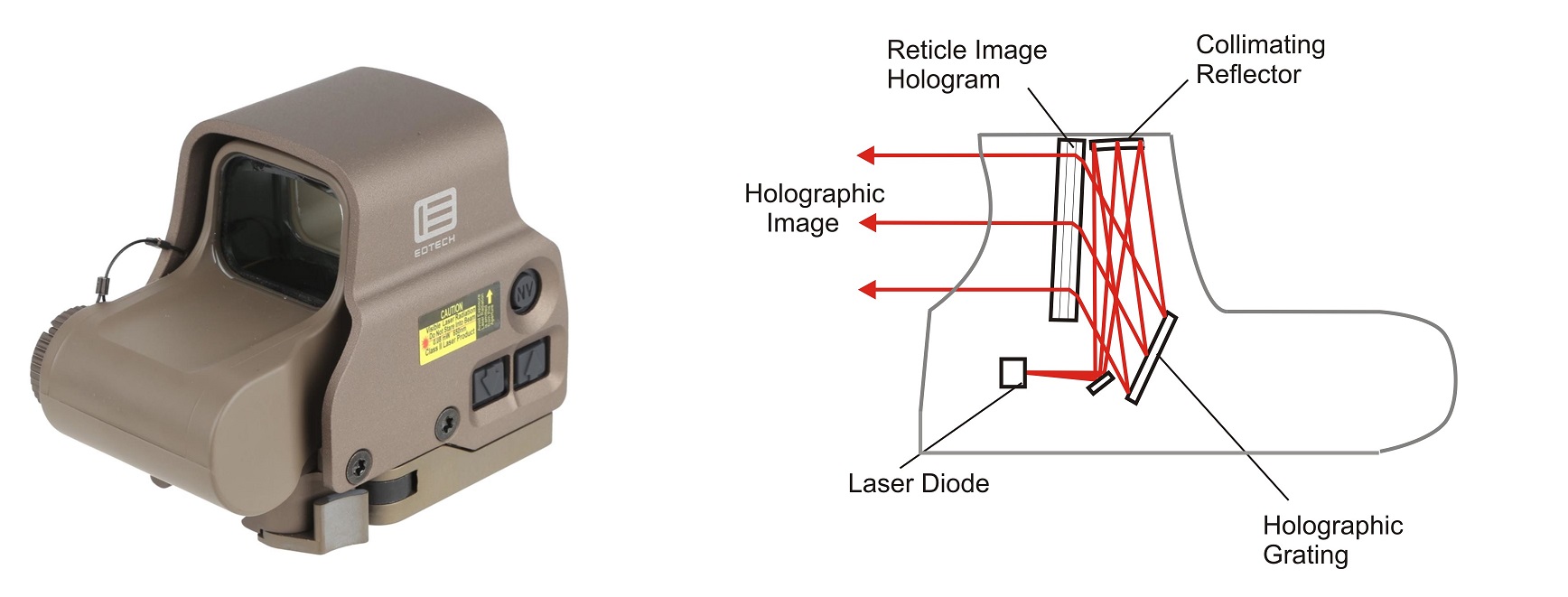
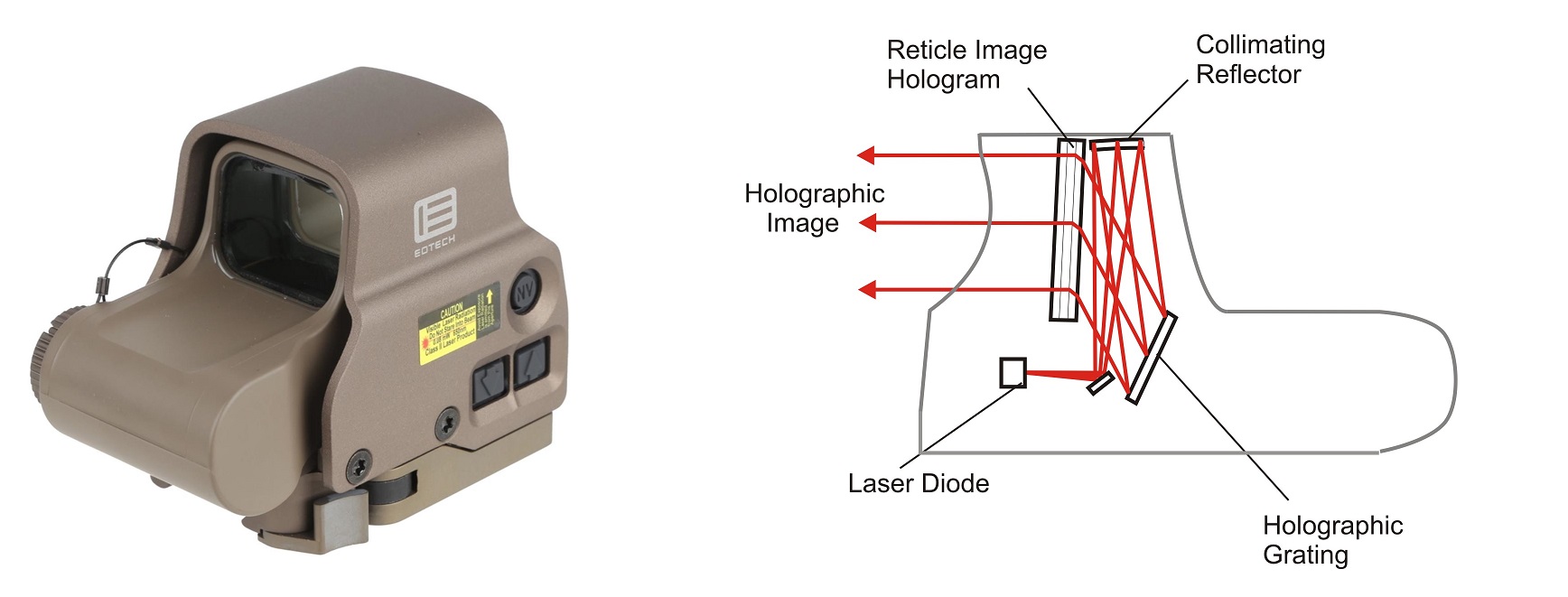
Holographic sights, like the EOTech EXPS-3 shown above, produce an aiming reticle that looks identical to that of a reflex sight. But unlike reflex sights, holographic sights use a laser diode instead of an LED as the reticle’s light source.
How holographic sights create a reticle:
Holo-sights also use mirrors to shape and project the reticle onto a pane of glass in front of the shooter’s eye, rather than reflect the reticle directly back at the shooter’s eye. In this case, the reticle you’re looking at is floating in front of you, literally, like a hologram.
Holographic sight reticles tend to produce a reticle that’s “cleaner” in appearance, and that’s thanks to a more precise method of producing the reticle’s shape. Instead of placing a filter (diaphragm) over the diode, the laser is dispersed into parallel beams using a collimating reflector. Those beams strike a high-resolution lens called a holographic grating. This lens produces the reticle on the shooter’s viewing glass with high clarity and sharpness.
Pros
- Holo-sights suffer no parallax error: The reticle remains fixed, regardless of your eye position.
- Holographic sights use thicker, tougher glass that can withstand more abuse than a reflex sight.
- A holographic sight’s glass pane can still project a reticle when cracked or chipped.
- Holographic reticles tend to be brighter, cleaner, and easier to see than reflex reticles.
Cons
- Holographic sights are much more complex in their design and construction.
- Holographic sights can cost twice to four times as much as a reflex sight.
- Holographic sights are heavier and bulkier than reflex sights.
- Holo-sights also require more power battery than reflex sights.
Reflections vs. Holograms
Still confused? Think of a reflex sight as a single mirror. When a light is pointed at the mirror, it’ll bounce off the reflective surface, back toward your eye. If you move your eye, the light will no longer hit your eyeball but will continue traveling in its original direction.
Since the reflex reticle’s position relative to the target depends on your eye position, changing your sight picture while aiming will make it appear as though the reticle’s point of aim is changing, too.
Think of a holographic sight’s reticle as a floating object trapped insight a glass box. When its laser is pointed into the box, the light is trapped and focused at the center of this box. You can look inside this box to see the laser’s image. No matter where you move your eye, the floating image (the reticle) remains in the same spot.
Since the position of holographic’s reticle remains independent of your eye, changing your sight picture will not change the reticle’s point of aim. If the reticle is on-target, it will remain on-target regardless of where your viewing eye is located behind the optic.
FAQ & Recap
Now you know the difference between red dot/reflex sights, and holographic sights. Here are the important points to remember:
- Reflex sights use a single pane of glass and an LED.
- Reflex sights reflect the LED directly at the shooter’s eye.
- Holographic sights use a laser diode to produce a reticle.
- Holographic sights capture the reticle as a hologram within the optic.
- Holographic sights are parallax-free; eye position doesn’t affect point of aim.
- Reflex sights are affected by parallax; changing eye position changes point of aim.
Q: Which type of red dot optic is better for me?
A: Reflex sights are much more affordable. They’re simpler, too. Parallax error can affect a reflex sight’s accuracy, but this effect is mild and only becomes noticeable if your sight picture is inconsistent at long-range.
Q: Can holographic and reflex sights be magnified?
A: Yes, both can be magnified. Magnifying a holographic sight or reflex sight will enlarge both the reticle and everything within the sight picture that’s viewed downrange.
Q: How does battery life compare between the two optics?
A: Reflex/red dot sights can provide up to 50,000 hours of battery life or more. Holographic sights require more power and can function for up to 1,000 to 5,000 hours.
Q: What kind of batteries do red dots and holographics use?
A: Both optics often use AAA, AA, or CR123 batteries. CR123-operated units operate at higher voltages and tend to provide the brightest reticles with the most battery life.
Q: Should I go with a red or green dot optic?
A: Red light is easier to see in low light and it won’t dilate your eyes or kill your night vision like green light. Green light can provide slightly better clarity in daylight conditions.
Q: Which red dot’s best for a handgun and rifle?
A: Micro-reflex sights like the Sig Romeo1 PRO are incredibly small and can fit easily on most pistols. Holographic sights can provide a slight edge for a rifle, but are typically too large for placement on handguns.